
Vietnamese quartz stone
Vietnamese quartz stone is more suitable for the U.S. market due to its five core advantages. For one thing, no anti-dumping duty cuts costs, while cost-effectiveness meets value demands.
For another, rich varieties and specifications adapt to diverse needs, and good after-sales eases cooperation worries. Ultimately, it will occupy a larger U.S. market share as Vietnam’s industry develops.
Vietnamese quartz stone has become increasingly popular in the U.S. market. Unlike other exporting countries, it has unique advantages that match U.S. buyers’ needs, especially budget hotels and construction projects. Moreover, its core strengths make it more suitable than alternatives.

Core Advantages of Quartz Stone for the U.S. Market
1. No Anti-Dumping Duty: A Core Cost Advantage
First and foremost, Vietnamese quartz stone enters the U.S. market without anti-dumping duty, a key edge. Since 2019, the U.S. has imposed up to 333.09% anti-dumping duties on Chinese quartz stone, thereby making it uncompetitive.
In contrast, Vietnamese quartz stone avoids this burden, whether locally produced or legally processed. Additionally, U.S. court rulings confirm its legal import, directly reducing costs for U.S. buyers.
2. High Cost-Effectiveness: Balancing Quality and Price
Besides tax benefits, Vietnamese quartz stone offers high cost-effectiveness, which aligns with the U.S. market’s value focus. For instance, Vietnam has abundant raw materials and low labor costs, enabling reasonable pricing.
Furthermore, most factories use modern technology and strict quality control, meeting international standards. As a result, it has a 20-30% price advantage over European and U.S. quartz stone, making it ideal for budget-conscious buyers.
3. Rich Varieties: Meeting Diverse Aesthetic and Functional Needs
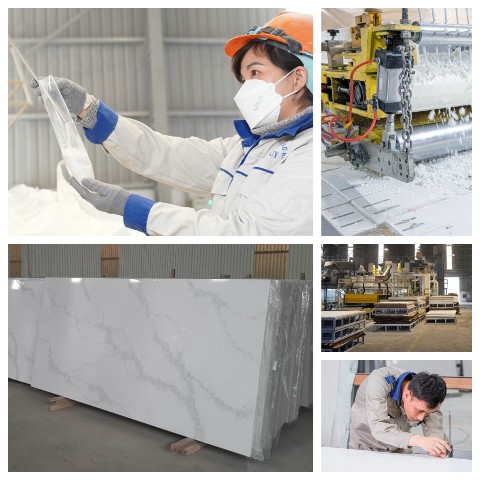
Additionally, Vietnamese quartz stone has rich varieties to meet the U.S. market’s diverse needs. For example, local manufacturers offer basic series, Calacatta, Carrara, and advanced full-body printed quartz with natural patterns.
These varieties cover classic to modern styles, adapting to residences, hotels, and commercial spaces. Consequently, buyers can easily find matching options for budget hotels or luxury projects.
4. Diverse Specifications: Adapting to U.S. Project Requirements
Along with rich varieties, Vietnamese quartz stone also comes in diverse specifications, thus boosting its U.S. market adaptability. Specifically, factories produce regular (126×63’’) and super-jumbo (137×78’’) sizes, with 2cm, 3cm, and 1.2-1.5cm thin slabs.
Some even offer 3600×2000mm giant slabs, the market’s largest. This not only reduces splicing but also improves efficiency for large U.S. projects, effectively matching varied construction needs.
5. Excellent After-Sales Service: Solving U.S. Buyers’ Worries
Last but not least, Vietnamese manufacturers provide top-tier after-sales service, which eases U.S. buyers’ concerns. For example, most offer 7/24 online support, customized reports, and free spare parts when needed.
Moreover, shipment is timely: 20-30 days to the U.S. west coast and 35-45 days to the east coast. Additionally, R&D teams continuously develop new designs to keep up with global trends.
Vietnamese Quartz Stone vs. Other Exporting Countries
The U.S. quartz stone market has huge demand, with Vietnam as a top exporter. Notably, its combined advantages make it stand out in fierce competition for U.S. buyers.
Therefore, choosing Vietnamese quartz stone helps budget hotels, construction firms, and distributors cut costs while ensuring quality and stable supply.
Compared to other exporters, Vietnamese quartz stone is more targeted. For example, European quartz is high-quality but expensive, while Chinese quartz faces heavy anti-dumping duties.
In contrast, Vietnamese quartz balances cost, quality, and service, eliminating cost pressure and meeting diverse demands with smooth cooperation.
Quality Recognition and Market Adaptability in the U.S.
Vietnamese quartz stone is widely recognized in the U.S. for its quality. Specifically, factories use high-quality raw materials and strict control, ensuring stable color, structure, and durability.
Furthermore, many products pass SGS and other international certifications, meeting U.S. environmental and safety standards. As a result, it has become a reliable choice for U.S. buyers.
Adaptability to U.S. Budget Hotels
For U.S. budget hotels, Vietnamese quartz stone’s advantages are particularly prominent. For instance, it helps control decoration costs via no anti-dumping duty and high cost-effectiveness.
Additionally, its rich varieties and specifications let budget hotels choose suitable quartz for guest rooms, restaurants, front desks, and other areas.
FAQ
1. Does Vietnamese quartz stone face anti-dumping duty when exported to the U.S.?
No. Unlike Chinese quartz stone (which faces up to 333.09% anti-dumping duties since 2019), Vietnamese quartz stone enters the U.S. market duty-free. U.S. court rulings also confirm its legal import when following proper procedures.
2. Why is Vietnamese quartz stone cost-effective for the U.S. market?
Vietnam has abundant quartz raw materials and low labor/production costs. Most factories use modern technology and strict quality control, so it offers a 20-30% price advantage over European and U.S. quartz stone while meeting international standards.
3. What varieties of Vietnamese quartz stone are available for the U.S. market?
It has rich varieties, including basic series, Calacatta, Carrara, and advanced full-body printed quartz with natural stone patterns. These cover classic to modern styles, fitting residences, hotels, and commercial spaces.
4. What specifications does Vietnamese quartz stone offer for U.S. projects?
Specifications are diverse: regular (126×63’’), super-jumbo (137×78’’) sizes, 2cm/3cm thickness, and 1.2-1.5cm thin slabs. Some factories even provide 3600×2000mm giant slabs to reduce splicing.
5. What after-sales service do Vietnamese quartz stone manufacturers provide for U.S. buyers?
Most offer 7/24 online support, customized production/inspection reports, and free spare parts. Shipment is timely: 20-30 days to the U.S. west coast and 35-45 days to the east coast, with ongoing R&D for new designs.
6. How does Vietnamese quartz stone compare to other exporting countries?
European quartz stone is high-quality but expensive; Chinese quartz stone faces heavy anti-dumping duties. Vietnamese quartz stone balances cost, quality, and service, making it more targeted for the U.S. market.
7. Is Vietnamese quartz stone recognized for quality in the U.S.?
Yes. Factories use high-quality raw materials and strict quality control, ensuring stable color and durability. Many products pass SGS and other international certifications, meeting U.S. environmental and safety standards.
8. Is Vietnamese quartz stone suitable for U.S. budget hotels?
Absolutely. Its no anti-dumping duty and high cost-effectiveness help control decoration costs. Rich varieties and specifications also let budget hotels choose suitable options for guest rooms, restaurants, and front desks.
9. Can thin-slab Vietnamese quartz stone be used for all U.S. project areas?
No. Thin-slab (1.2-1.5cm) quartz stone is only for non-load-bearing, low-traffic areas (e.g., guest room desks). It is strictly prohibited for kitchens or front desk countertops to avoid cracking.
10. How to test the authenticity of Vietnamese quartz stone on-site?
Use three simple tests: scratch with a key (genuine leaves metal marks), drop white vinegar (no bubbles for genuine), and do a 10-minute soy sauce test (genuine wipes clean without traces).